Grewlin — Cognitive OS

Governing intelligence over time.

Grewlin is a Cognitive Operating System for governed autonomy — maintaining authoritative state, validating every transition before commit, and bounding execution by architecture.

Proven first in industrial systems: deterministic physical validation detects developing failures, identifies likely causes, and supports earlier governed action in demonstrated failure scenarios.

Cognitive OS Kernel — governed state evolution
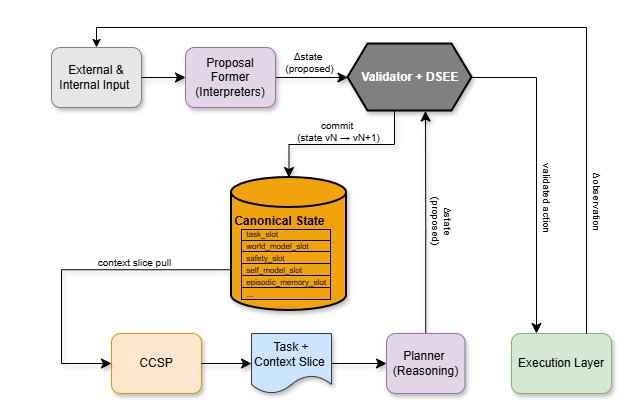
Cognitive OS Kernel — governed state evolution diagram
Authoritative state Canonical Cognitive State All reasoning operates against a single persistent, authoritative representation. No implicit belief formation, no context reconstruction.
Before commit Validation → Commit Every proposal — from a human, agent, or system — is validated before it changes state. Invalid or unauthorized transitions are rejected.
Deterministic State Evolution Every transition has a defined predecessor and a recorded outcome. The full history of the system is replayable and forensically auditable.
Bounded autonomy Authority Enforcement Execution is authorized only by committed state. No component can assume permissions, infer authority, or act outside explicitly validated bounds.
Pilot-ready implementation

The Cognitive OS in Autonomous Industrial Governance.

A physics-invariant cognitive twin governs real-time fault detection and identification in continuous industrial processes. Calibrated physical rules identify affected equipment and likely failure mechanisms, trace causal chains, and compute time-to-boundary. The resulting evidence is auditable, deterministic, and falsifiable — and can support bounded autonomous response where explicitly authorized. Benchmarked at scale against the Tennessee Eastman Process (Rieth et al. 2019) — a widely used reference for continuous process fault detection.

No black-box model — every alarm is falsifiable
0 false positives across 500 normal-operation benchmark runs
HAZOP-aligned invariant derivation
Equipment identification and causal-chain tracing
Works with existing historian data
No changes to control system
TEP Benchmark — 10,500 simulation runs — Rieth et al. 2019, Harvard Dataverse
Detection rate
98.09%
DR on physically observable faults — controller-absorbed faults excluded by construction
False positive rate
0.0%
0 false alarms across 500 normal-operation benchmark runs — evidence of low alarm fatigue under the evaluated conditions
Stochastic fault IDV(19)
84.8%
424/500 runs — physically explained detection limit
Benchmark scale
10,500
simulation runs · 960 steps each · 3-min sampling
Physics-invariant digital twin — detection, fault identification, and subsystem attribution backed by calibrated physical rules. See identification evidence →
Critical infrastructure security

The same deterministic core, guarding water infrastructure.

A compromised PLC can falsify both its reported state and the alarms intended to reveal the compromise. Grewlin independently validates raw sensor and actuator telemetry against a physics-based model of the plant, determining whether the reported state remains physically possible. This provides a separate layer of detection even when control logic or controller-generated alarms can no longer be trusted.

The approach has been benchmarked on SWaT, a six-stage water-treatment research testbed developed for cyber-physical security evaluation, using the same reasoning core built for TEP.

Detects physically consequential PLC manipulation independently of on-device alarms
Compared with the published GiBy baseline (78.5%)
High benchmark precision limits false-alert burden (~97%)
Same deterministic architecture shared with TEP
SWaT A1 Benchmark — 6-stage water treatment plant — iTrust, SUTD
Attack-level detection
31/36
86.1% of attack episodes detected — above the 78.5% reported by the published GiBy baseline under its evaluation
Precision
96.95%
supports a low false-alert burden under the evaluated conditions
F1 score
88.48%
44,412 TP · 1,398 FP · 10,172 FN · 888,937 TN across 944,919 rows
Recall
81.36%
remaining misses include attacks with limited observable physical impact
Cross-layer invariant guards detect attacks and localize evidence to the implicated subsystem and equipment. See identification evidence →
Real-world incident replay

Buncefield, December 2005.

Hertfordshire Oil Storage Terminal. Tank 912 was filling at 550 m³/h when the primary level gauge froze. The backup switch had not been maintained and also failed to operate. 300 t of petrol overflowed, formed a vapour cloud, and exploded. £1 billion in damage. 43 injured. The first physical inconsistency is detected 6 hours before overflow; emergency transfer stop is initiated 1 hour before predicted overflow.

Incident replay · Buncefield 2005 · Tank 912 · 23,000 m³ · 550 m³/h
Without Cognitive OS
Tank 912
ATG
↑ INFLOW
— ATG reading
- - HH alarm
Time
19:00
Actual Level
28.2%
ATG Reading
28.2%
⚠ FROZEN — DO NOT TRUST
HH Alarm
— NOT TRIGGERED
Cognitive OS — invariant engine
✓ 02:00 — EMERGENCY STOP — Transfer halted — 1 hour before overflow
💥 03:00 — OVERFLOW — 300 t petrol released — vapour cloud — explosion
Replay based on the documented incident timeline.
Step — / 9 Full incident replay →

Source: MIIB Final Report, December 2008 · Replay: Grewlin Cognitive OS incident engine · First detection: 6 hours before overflow

Traditional systems wait for a threshold to be crossed. Grewlin detects physical inconsistency immediately — the moment inflow and level readings can no longer be reconciled.

Research-led Patent-pending Architecture-first Long-horizon AI Governed autonomy
Deployment

Detect developing failures before they become incidents.

The simulation shows what Buncefield looked like in hindsight. Grewlin continuously validates your process to identify physically inconsistent and developing failure conditions before they become irreversible.

Input Your existing historian or SCADA data — no control system changes required
Timeline 4–8 week pilot — invariants calibrated to your plant, validated live
Output Validated detections with equipment identification, failure fingerprinting, causal chains, and time-to-boundary — supporting operator decisions and bounded autonomous response where explicitly authorized
Start a pilot →
What this is

This is not anomaly detection.
This is deterministic state validation from detection to governed action.

Anomaly detectors wait for a threshold to be crossed. Grewlin reasons from physical invariants — mass balance, flow consistency, instrument coherence — and detects the contradiction the moment it becomes physically impossible to ignore. No conventional process alarm threshold needs to be crossed, and no controller alarm needs to fire.

Detection establishes that the state is inconsistent. Identification connects that evidence to affected equipment, likely failure mechanisms, and a causal chain. Only validated state can authorize a response, and execution remains inside explicit operating and authority bounds.

At Buncefield the ATG was inconsistent with inflow from the first frozen reading. In the replay, Grewlin flags that inconsistency, computes time-to-boundary, and gives operators 6 hours to act. A pilot applies the same validation approach to your process.

The architectural gap

Current AI architectures were not designed for long-horizon autonomy.

As AI moves from short interactions toward persistent, autonomous operation, current architectures cannot provide enforceable guarantees for what matters most. These are not model failures. They are architectural failures.

Gap 01

Long-horizon consistency

Agent frameworks reconstruct state from context every time. Drift is undetectable and unrecoverable without authoritative state ownership.

Gap 02

Reliable memory and task continuity

Without persistent task state, long-running work cannot be resumed, audited, or verified across sessions or system restarts.

Gap 03

Safe coordination across agents

Emergent consistency between co-operating agents is non-deterministic and provides no governance guarantees at the system level.

Gap 04

Explainability and auditability

Without deterministic state transitions, autonomous decisions cannot be forensically reconstructed or proven after the fact.

Gap 05

Federated operation at scale

Distributed AI systems without shared authoritative state become independent agents with no enforceable system-level invariants.

The answer

A Cognitive Operating System

Not a better model. A governed substrate that owns state authoritatively, validates changes before committing, and enforces execution bounds by construction.

Architectural primitives

Six primitives. One governed substrate.

These primitives define what the system can guarantee about reasoning, memory, task continuity, and execution — independent of models, agents, or applications.

PRIMITIVE 01

Canonical Cognitive State

A persistent, authoritative representation of knowledge, intent, and task state. All reasoning operates against this. No implicit belief formation.

PRIMITIVE 02

Deterministic State Evolution

Every state transition has a defined predecessor, a recorded proposal, a recorded validation outcome. Commits only if approved. Fully replayable.

PRIMITIVE 03

Validation Before Commit

Reasoning components propose; only validated changes commit to canonical state. Failures are contained before execution, not corrected afterward.

PRIMITIVE 04

Separation of Reasoning and Execution

Actions are authorized only after governed state transitions. Components cannot infer authority, assume permissions, or act outside validated bounds.

PRIMITIVE 05

Typed Tasks and Subtasks

Long-running work is first-class structured state, not prompt fragments. Tasks carry scope, dependencies, retry budgets, and output contracts.

PRIMITIVE 06

Federated Operation

Coordination across agents, robots, or services through shared authoritative state. Governance guarantees extend across distributed components by architecture.

Where Grewlin applies

Domain-agnostic. Wherever AI must operate reliably over time.

The Cognitive OS applies wherever long-horizon consistency, bounded autonomy, and forensic auditability are requirements — not aspirations.

Humanoids and embodied systems

Persistent cognitive state, long-term memory, and governed motor control for ROS-based humanoids.

Research direction

Autonomous industry and logistics

Physics-invariant fault detection benchmarked at scale — ready for pilot deployment in continuous industrial and water treatment processes.

Pilot ready

Vehicles and autonomous fleets

Federated cognitive state with deterministic coordination and authority-bounded autonomy.

Research direction

Enterprise AI agents

Copilots and agents that retain authoritative state and remain governable as they scale.

Research direction

Safety-critical and regulated

Architecture designed to support alignment paths for the EU AI Act, NIST AI RMF, IEC 61508, and ISO 26262.

Research direction

Space and autonomous spacecraft

Governed state for systems operating under communication delay, partial observability, and no human in the loop.

Research direction
Demonstrated applications

The Cognitive OS in practice.

Working implementations of Cognitive OS principles — not reference architectures.

AI Governance by Architecture

Human oversight enforced by system architecture.

As AI moves toward autonomous operation in safety-critical and societal domains, governance can no longer rely on policy, monitoring, or human reaction time. It must be enforced by architecture.

Grewlin governs autonomy at the cognitive operating system level — through explicit authority modeling, validation-before-commit, deterministic behavior, and execution gating. Autonomous components cannot assume authority, bypass validation, or exceed defined operational bounds.

→ How Grewlin enforces governed autonomy
Continuous governance
Non-bypassable
Forensically traceable
Deterministic
Bounded autonomy
Regulator-aligned
EU AI Act alignment path
NIST AI RMF alignment
IEC 61508-compatible path
ISO 26262-compatible path
Context-limited
Provable

Framework references describe architectural alignment goals; Grewlin has not been independently certified against these standards.

What makes this different

Models
generate ideas.
Agents
coordinate actions.
Grewlin
governs cognition.

Grewlin does not compete with models, agents, or tools. It provides the missing architectural layer that allows them to work together safely, coherently, and under explicit governance — at any horizon.