Grewlin — Autonomous Industry · Pilot ready

Detect physical inconsistency. Identify the cause. Govern the response.

Grewlin validates whether the reported plant state is physically possible, identifies the likely source of inconsistency, and permits only responses that remain within explicitly configured authority and safety boundaries.

Validated on the Tennessee Eastman Process: 98.09% detection on physically observable faults and 0 false alarms across 500 benchmark normal-operation runs.

Why industrial autonomy is different

Industrial systems cannot rely on probabilistic confidence alone.

Industrial decisions unfold over time, interact with physical processes, and can produce irreversible actions. Conventional alarms identify threshold violations. Statistical models identify unusual patterns. Neither alone creates the authoritative, validated state required to authorize action safely.

GAP 01

Physical actions are irreversible

Valve operations, equipment actuation, and process changes cannot always be undone. Governance must evaluate a proposed response before execution.

GAP 02

Long-running autonomy accumulates state

Decisions span shifts, incidents, and system boundaries. A persistent authoritative state is needed to prevent context drift and conflicting interpretations.

GAP 03

Policies cannot intercept execution

Guidelines describe intent but do not enforce runtime transitions. Safety envelopes, authority, and validation must be part of the execution path.

GAP 04

Logs do not prove why authority was granted

Post-hoc records show what happened. Accountability also requires the state, constraints, evidence, and authority that justified or rejected an action.

01
Telemetry
02
Invariant validation
03
Canonical state
04
Identification
05
Time-to-boundary
06
Validated response
Validated implementation

Benchmarked at scale on the Tennessee Eastman Process.

The Grewlin cognitive twin was benchmarked against the Rieth et al. 2019 Harvard Dataverse dataset — a widely used chemical-process fault-detection benchmark covering 20 fault types across 10,500 simulation runs (500 normal-operation runs + 500 runs per fault type). Three fault types (IDV(3), IDV(9), IDV(15)) produce no distinguishable physical signature in the available benchmark measurements and are therefore not detectable from those signals.

Detection rate
98.09%
DR on physically observable faults — faults without a distinguishable signature in the available benchmark measurements are excluded from this denominator
False positive rate
0.0%
zero false alarms on 500 normal-operation baseline runs
Stochastic fault IDV(19)
84.8%
424/500 runs detected — physically explained detection limit for this fault archetype
Benchmark scale
10,500
simulation runs · 960 steps each · 3-minute sampling interval
What the benchmark supports
✓
Low false-alert burdenA low false-alert burden makes it more practical for operators to investigate and act on each alert.
✓
Earlier fault detectionInvariant violations can surface before conventional alarm thresholds in demonstrated failure scenarios, buying time for intervention.
✓
A prerequisite for bounded automationLow false-alert burden helps; response still requires validated diagnosis, authority limits, and safety checks.
✓
Decision traces for evidence needsEach alarm carries its physical invariant, evidence, and severity in a machine-readable, reconstructable trace that may support regulatory evidence needs.
How detection works
Physics-invariant rules
Every detection is produced by a calibrated physical invariant — a rule grounded in heat balance, mass flow, or thermodynamic constraint. No learned model, no black box. Each alarm is falsifiable and auditable by engineering staff.
Digital twin runtime
The Grewlin Twin Runtime evaluates invariant rules against live process snapshots. Rule tolerances are calibrated from normal-operation history so they do not fire on the calibration baseline; performance on each plant is then evaluated during an advisory pilot.
Compound detection
Soft compound-threshold rules fire when two sub-threshold anomalies co-occur across physically correlated signals — detecting faults that neither signal alone would catch. The compound condition is physically motivated: both signals are driven by the same root cause.
Audit trace
Every detected event carries a structured finding: rule ID, severity, evidence dictionary, and the physical invariant that was violated. The audit trail is machine-readable and forensically reconstructable — not a log, a first-class system output.
Detection to diagnosis

Identification turns a valid detection into operational evidence.

Detection establishes that the process state is physically inconsistent. Identification narrows that evidence to a fault class, subsystem, or attacked component — the structured diagnosis needed to evaluate which responses are justified, safe, and authorized.

Tennessee Eastman Process

Fault-class and subsystem attribution

Macro-averaged identification results across the TEP fault classes, scored separately from detection.

Curated exact fault ID
53.1%
17 IDVs with a curated PG-CDI hypothesis
Overall exact fault ID
45.2%
all 20 IDVs
Correct subsystem
83.2%
curated set; 70.7% overall

Scope: IDV(3), IDV(9), and IDV(15) have no curated distinguishable fault signature and are excluded only from the 17-IDV figures. Equipment-level TEP identification is not yet benchmarked.

TEP benchmark dataset →
SWaT A1 cyber-physical benchmark

Attack, subsystem, and equipment localization

Conditional results across the 31 detected attacks, with strict identification separated from broader evidence coverage.

Curated exact ID
74.2%
23/31 detected; 23/36 overall
Correct subsystem in evidence
93.5%
29/31 detected attacks
Attacked equipment in evidence
87.1%
27/31 detected attacks

Scope: subsystem and equipment results are coverage metrics, not top-1 localization precision. They count whether the correct stage or attacked tag appeared in the evidence, which may also implicate other equipment. Five undetected episodes are excluded.

View the SWaT research →
Why identification matters for autonomy

A detection can alert an operator. A validated diagnosis adds the affected subsystem, likely failure mechanism, causal evidence, and time-to-boundary. That structured state can support operator decisions today and bounded autonomous response where authority, confidence, and operating limits are explicitly configured.

How detection becomes governed action

Validated state governs what may happen next.

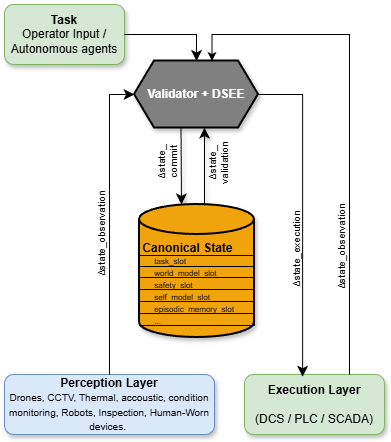
Grewlin introduces a governed Cognitive Operating System that maintains a persistent, authoritative canonical cognitive state across the full operational context.

Process state
Industrial process state, physical-world observations, and equipment status — held as first-class system knowledge, not reconstructed from logs.
Safety context
Safety envelopes, hazard states, and human presence are part of the canonical cognitive state. Every proposed action is validated against them before execution.
Engineering intent
Design intent and capability contracts constrain what actions are allowed — ensuring that autonomous behavior remains aligned with engineering rationale, not just runtime observations.
Operational history
Episodic operational history carries context across shifts, failures, and system boundaries — so the system does not start from zero with each inference or session.
Cognitive OS architecture: Validator and DSEE governing Canonical State, with Perception Layer inputs and Execution Layer outputs
No training
Rules are calibrated from normal-operation history and validated against the deployment context. No learned model weights or opaque policy.
Deterministic
Every decision is a rule evaluation against the canonical state. Same input, same output — always explainable, always auditable.
Applied at runtime
Validation runs inline against live process data — before any action is committed to the DCS/PLC/SCADA layer.

Safety and governance controls are enforced within the governed execution path, rather than added as optional policies.

Graduated autonomy

Autonomy introduced in phased, controllable modes.

The architecture does not assume that full autonomy should be enabled immediately. The same governance layer supports staged deployment from advisory monitoring to bounded autonomous execution.

What becomes possible

Capabilities required for governable industrial autonomy.

With a governed Cognitive OS in place, industrial systems gain the continuity, coordination, bounded authority, and auditability needed for staged autonomy.

01

Multi-step task coherence

Tasks remain coherent across shifts, systems, and time — rather than resetting with each inference or dashboard session. The cognitive state carries full context across the operational lifetime.

02

Coordinated operational response

Validated findings can coordinate process areas, equipment context, and operator workflows while each response remains inside an explicit authority scope.

03

Safe delegation of bounded authority

Machines act independently within validated safety envelopes — without bypassing human accountability structures or certified control systems (SCADA, DCS, PLC, SIS).

04

Forensic decision reconstruction

Each authorized autonomous decision retains what the system knew, which constraints applied, what proposals were considered, and why an outcome was authorized or rejected. The resulting trace can support audit and regulatory evidence needs months or years after execution.

In practice

Example: Reactor cooling-water degradation.

The product story in miniature: observation, physical contradiction, diagnosis, predicted consequence, and a response constrained by authority.

Traditional monitoring
  • ✗ Misses early drift — individual signals stay within threshold
  • ✗ Correlated signals must be assembled and interpreted manually
  • ✗ No physical explanation — operators must investigate manually
Grewlin
  • ✓ Observation: reactor-temperature residual rises while coolant flow diverges
  • ✓ Contradiction: heat-balance and flow-consistency invariants fail together
  • ✓ Diagnosis: evidence narrows to the cooling-water path and likely valve or exchanger degradation
  • ✓ Consequence: time-to-boundary estimates when the validated safety envelope may be reached
  • ✓ Response: advisory, supervised, or bounded action is surfaced only if authorized
Why Grewlin is different

From signals and alerts to validated, governed state.

Grewlin complements existing monitoring and control systems by connecting physical evidence, persistent state, diagnosis, and execution authority.

Approach Typical boundary Grewlin contribution
Threshold alarms Typically evaluate predefined limits and often provide limited causal or cross-signal interpretation. Validates physical consistency across related signals and retains the evidence in canonical state.
ML fault detection Often requires representative training data and may provide limited physical explanation or require adaptation after process changes. Uses explicit physical invariants whose triggers, evidence, and operating bounds can be inspected by engineers.
SCADA / DCS monitoring Makes process data visible, while interpretation and response authority remain distributed across operators and control logic. Creates a validated state that connects observations, constraints, diagnosis, and authorized response.
Policy / rule engines Generally do not provide persistent authoritative state, governed transitions, and execution authority as one integrated architecture. Validates proposed state changes before commit and gates execution against explicit authority.
Model-based observers Can depend on model fidelity and may need adaptation when plant behavior or operating regimes change. Does not require a complete high-fidelity dynamic model; invariants combine engineering relationships with calibrated normal-operation bounds.
Pilot program

Low risk. High signal. Pilot in your plant.

A 4–8 week, read-only engagement measured against your real operational data, incidents, and engineering assessment.

1 · Connect
Use a read-only historian or SCADA export — no new sensors, instrumentation changes, or write access to the control system.
2 · Model
Derive plant topology, process relationships, candidate invariants, and relevant safety boundaries with your process engineers.
3 · Calibrate & replay
Calibrate HAZOP-aligned invariants against normal-operation history, then replay known incidents and near-misses to evaluate detection, lead time, and attribution.
4 · Validate live
Run in advisory-only mode and compare findings with operator and engineering assessment before any higher-authority mode is considered.
Success criteria
Measure false-alert burden, known-incident detection, lead time, subsystem attribution, engineering acceptance of explanations, and data/integration effort.
Start a pilot inquiry →

The Grewlin position

Industrial systems
act autonomously.
Grewlin
governs every authorized autonomous decision.
Architecture
is the safety layer.

Benchmarked at scale, backed by physics, ready for pilot deployment in your process environment.