A family of U.S. provisional patent applications establishing priority across the Cognitive Operating System architecture.
A coordinated set of US provisional patent applications establishing priority across the full Cognitive Operating System stack — from core reasoning primitives to embodied robotic cognition, federated multi-unit coordination, task lifecycle management, and autonomous software engineering.
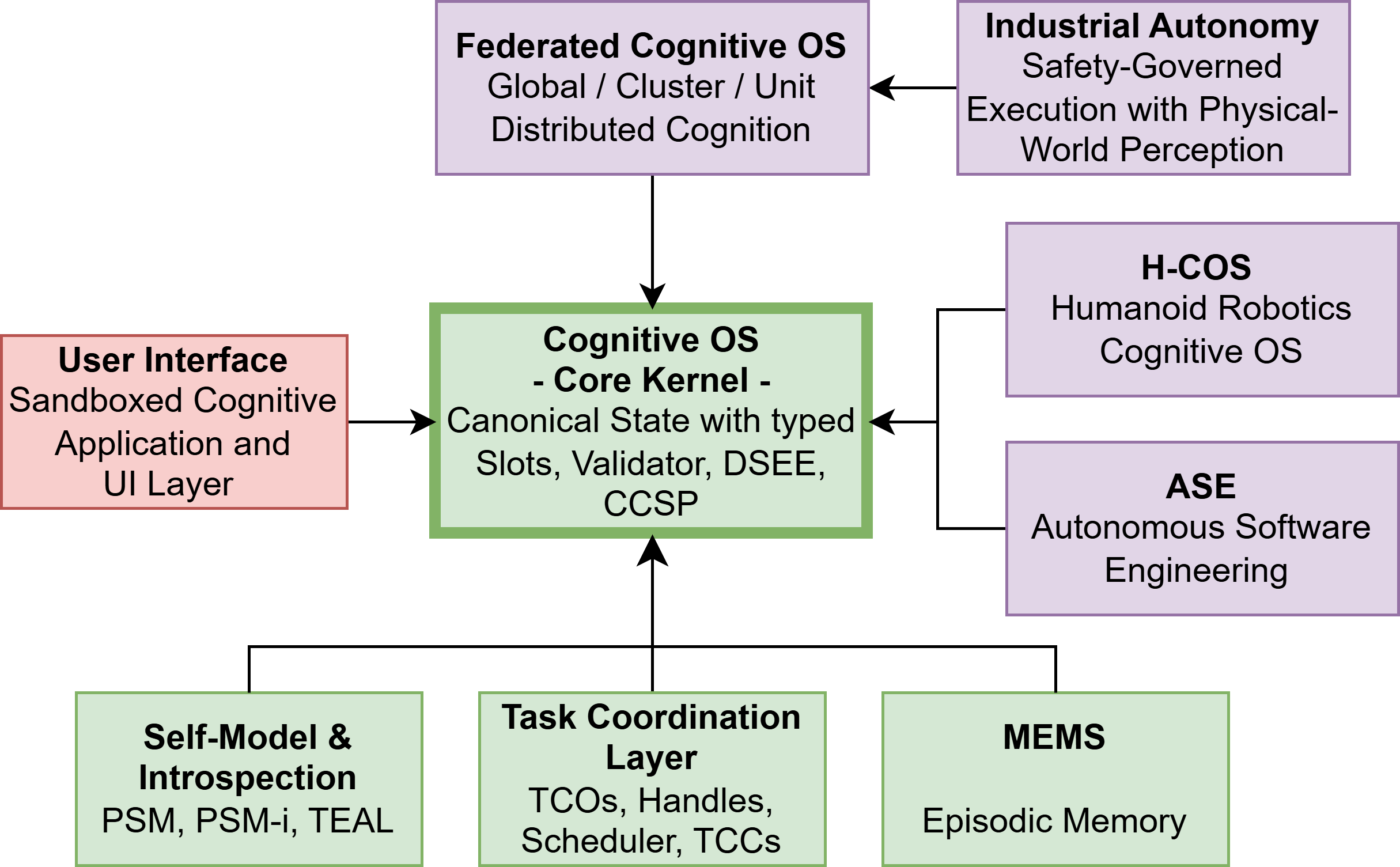
The family begins with AI-ROS (63/928,460), defining the core cognitive OS primitives: canonical state, deterministic state evolution, typed semantic slots, multi-agent coordination, and an append-only audit layer. Two companion filings extend this into embodied systems: MEMS (63/929,852) adds multisensory episodic memory; H-ROS (63/930,747) instantiates the full stack for humanoid robots.
PSM/TEAL (63/933,264) adds a persistent self-model and experience-based task adaptation. AI-ROS F (63/933,915) extends the architecture to federated multi-unit deployments. TCL (63/939,935) defines typed task context objects, subtask handles, and a deterministic scheduler with checkpointed lifecycles.
Further filings cover a sandboxed UI and application layer (63/951,154), the industrial autonomy embodiment (63/956,496), and the autonomous software engineering embodiment — deterministic validation gates, typed inter-scope contracts, and self-improving knowledge-base feedback loops.
AI Reasoning Operating System (AI-ROS)
A stateful, causal, multi-agent semantic memory and deterministic reasoning architecture for generative AI systems. Defines the foundational cognitive OS primitives: canonical state, deterministic state evolution engine, typed semantic slots, delta prompt protocol, dynamic persist logic, multi-agent coordination layer, and a replay and audit layer.
Multisensory Episodic Event Memory for Embodied Robots
Multisensory rolling buffer captures time-aligned sensory frames across vision, depth, audio, thermal, vibration, and proprioception; a Semantic Event Consolidation Engine segments them into typed episodic records with canonical labels, spatial grounding, and causal context. A Long-Term Episodic Event Graph and Multisensory Event Index drive a Predictive Reasoning Engine that adjusts navigation, manipulation, and posture from learned patterns — integrated with AI-ROS through deterministic state evolution and semantic integrity validation.
Humanoid Robotics Cognitive Operating System (H-ROS)
Cognitive OS for humanoid robots with eleven typed semantic memory slots, a Persistent Self-Model tracking joint health, behavioral tendencies, and performance history, and an evolving causal graph learning cause→effect relations from episodic experience. Nine specialized agents — perception, planning, safety, navigation, social, manipulation, introspection, causal induction, episodic consolidation — coordinate through delta-state updates governed by a Semantic Integrity Validator and safety-constrained action planning layer.
Persistent Self-Model & Experience-Based Adaptation (PSM/TEAL)
Persistent self-model (PSM) tracking capabilities, limitations, and performance history. Introspective meta-layer detecting reasoning inconsistencies and loops before they propagate. Contextual canonical state prioritization and a deterministic, weight-free task experience adaptation layer (TEAL) that applies prior episodic knowledge without modifying neural model parameters.
Federated Cognitive Operating System (AI-ROS F)
Hierarchical canonical state across global, cluster, and unit layers with a distributed deterministic state evolution engine. Multi-level reasoning and federated self-modeling for coordinated multi-unit and multi-facility autonomous systems — with distributed conflict resolution and a federated safety envelope propagated identically to all units.
Task Coordination Layer (TCL)
Typed task context objects with lifecycle state, capability contracts, and dependency graphs. Subtask handles with progress markers and completion conditions. Deterministic task scheduler, task dependency graph, checkpointed lifecycle model, rollback engine, and distributed task migration preserving deterministic execution semantics across autonomous units.
Sandboxed Cognitive Application & UI Layer
A sandboxed application and user interface layer running above the cognitive OS kernel. Defines the interface between user-facing cognitive applications, system-level canonical state, and the governed execution environment — separating application-level reasoning from kernel-level state management.
Safety-Governed Industrial Autonomy
Instantiation of the cognitive OS for autonomous industrial systems with physical-world reasoning. Enforces safety-governed decision making, structured hazard modeling, and deterministic execution for systems operating in physical environments — where decisions are irreversible and errors have real-world consequences.
Autonomous Software Engineering Cognitive OS
Software-engineering embodiment of the AI-ROS, PSM/TEAL, TCL, and Federated COS architectures. Hierarchical typed task scopes with exclusive file ownership, typed inter-scope contracts, actual-contract extraction via AST analysis, deterministic validation gate pipeline, gate-failure-conditioned prompt surgery, self-improving knowledge-base feedback loops, and auditable VTrace execution records.
Deterministic Invariant-Based Safety Validation, Diagnostic Activation, and Preventability Assessment for Industrial Process Systems
Covers the industrial fault-detection and incident-prevention embodiment of the Cognitive OS. Deterministic validation against calibrated physical invariants — mass balance, heat flow, thermodynamic constraint — applied at runtime to live process data. Diagnostic activation gates, preventability assessment, and append-only audit records for governed autonomous operation in continuous industrial processes.